
A Second Cat Just Came Home. Now What?
Cat Fights and Compatibility Problems
Tülay Kayalar Durukan — Cat Behavior Consultant
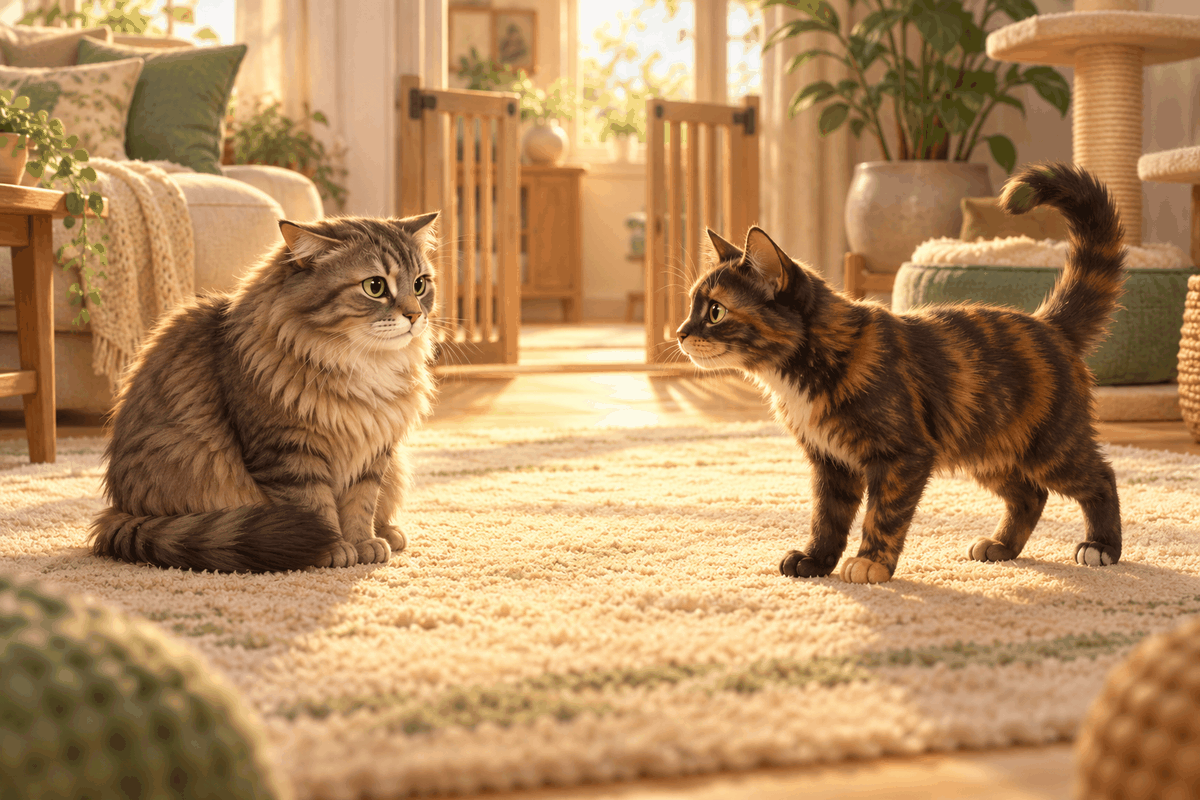
You share your life with one cat, and you decided to adopt a second. You pictured two cats sleeping together, grooming each other, living in peace under one roof... But things haven’t quite gone the way you imagined, have they?
From the moment your new cat came home, the hissing, growling, and chasing began. Maybe the cat who has lived with you for years suddenly changed. She’s not as affectionate as before, she’s hiding, she’s not eating, or she lunges at the newcomer the moment she sees her.
And now you’re asking yourself:
“Did I make a mistake by adopting a second cat?”
First, let’s say this: it’s completely normal for cats to react to each other when they first meet. But how those reactions are handled can have a big effect on the quality of the relationship that follows.
So let’s talk it through together: how a second cat settles into a home, why cats fight, and how you can manage the process in a healthier way.
First, let’s say this: it’s completely normal for cats to react to each other when they first meet.
Why Don’t Cats Want the New Cat?
We humans tend to assume our resident cat will be thrilled when a new cat arrives. After all, she’ll have a friend, she won’t be lonely, they’ll play together...
But in the cat world, things work a little differently.
For cats, home isn’t just a place to live. It’s the space where they feel safe, where they mark territory with scent, and where they build their daily routines.
A new cat arriving means that order is about to change.
And from your resident cat’s point of view, a complete stranger has suddenly become part of her living space.
For some cats this sparks curiosity. For others it can lead to fear, stress, or defensive aggression.
Here’s an important detail: not every hiss means aggression.
More often than not, a hiss is a way of telling the other animal, “I need some distance.”
But if these warnings are ignored, the situation can escalate into chasing, physical fights, and, over time, more serious behavior problems.
More often than not, a hiss is a way of telling the other animal, “I need some distance.”
The Biggest Mistake: Introducing Cats Right Away
One of the most common mistakes people make with a second cat is putting the two face to face the moment the new cat walks in.
“Let them sniff each other, they’ll get used to it.”
“They’ll fight a little, then work it out.”
“They’re both cats, why wouldn’t they get along?”
These thoughts can sound reasonable. But cats’ social relationships don’t work that simply.
If the first meeting involves intense fear or aggression, the cats may start to associate each other with bad experiences.
That’s why, instead of dropping the newcomer straight into the shared living area, you need to plan a controlled introduction.
Remember: helping cats get used to each other does not mean forcing them to stay in the same room.
Remember: helping cats get used to each other does not mean forcing them to stay in the same room.
What to Do First When the Second Cat Comes Home
In the first stage, set up a separate living space for your new cat.
This space should include:
- Food and water bowls
- A litter box
- A comfortable place to sleep
- Safe spots to hide
- A scratching surface
- Toys and environmental enrichment items
The new cat first needs to feel safe in this environment.
At the same time, it’s important that your resident cat can carry on with her daily life at home as close to her usual way as possible.
The new cat’s health status, vaccinations, and parasite treatments should also be assessed by a veterinarian. Especially for cats with an unknown health history, the risk of contagious disease needs to be addressed before the introduction.
The new cat first needs to feel safe in this environment.
How to Introduce Cats to Each Other
This is where you’ll need some patience. Cats may get used to each other in a few days, but it can also take weeks, and in some cases months.
- 1Stage one
Getting to know each other by scent
Cats experience the world largely through smell.
So the first meeting doesn’t have to be face to face.
You can place the bedding the cats use, or items that carry their scent, in each other’s living areas in a controlled way.
The goal is for the other cat’s scent to gradually become familiar and non-threatening.
What matters here is watching your cat’s reactions. If she shows intense stress at the scent, you need to slow the process down.
- 2Stage two
Positive experiences on both sides of a door
You can let the cats have enjoyable experiences on either side of a closed door, without seeing each other.
For example, you can serve their favorite food at a comfortable distance, or play with each cat separately.
The aim is to help them link the other cat’s presence with positive experiences.
However, if they stop eating, growl, or lunge at the door, increase the distance.
- 3Stage three
Controlled visual contact
Once the scent stage is going well, the cats can be allowed to see each other for short periods from behind a safe barrier.
At this stage, set things up so that both cats can easily move away.
If you notice a fixed stare, stiff tail movements, ears pinned back, a tense body, or signs of getting ready to attack, end the visual contact.
- 4Stage four
Short, controlled meetings
If the cats stayed calm in the earlier stages, you can plan short, supervised meetings in the same space.
The length of these meetings is increased based on how the cats respond.
After the first positive encounter, it’s not right to leave the cats together for hours.
The pace of the introduction should be set by the cats’ behavior, not by our expectations.
The pace of the introduction should be set by the cats’ behavior, not by our expectations.
What to Do If Cats Fight
First, you should know that not every chase or swat is a fight.
Cats can also chase each other, touch each other with their paws, and wrestle during play.
So how do we tell play from a real fight?
Play
During play, roles usually switch, the cats take short breaks, and neither one is forced to keep running away.
Real fight
In real conflicts, you may see intense growling, scream-like sounds, puffed-up fur, rigid body postures, biting, and one cat repeatedly cornering the other.
If the cats are truly fighting:
- Don’t step between them with your hands.
- Don’t yell, punish them, or spray them with water.
- Break visual contact with a safe barrier.
- Move the cats into separate spaces.
- If there’s an injury, see a veterinarian.
- Before going back to introductions, work out what caused the conflict.
Especially after serious fights, putting the cats back together as if nothing happened can cause the same behavior cycle to repeat.
Especially after serious fights, putting the cats back together as if nothing happened can cause the same behavior cycle to repeat.
Why Does the First Cat’s Behavior Change After the Second Cat Arrives?
Some cat owners are less surprised by the newcomer than by the changed behavior of the cat they’ve lived with for years.
“She used to come to me all the time, now she hides.”
“Since the new cat arrived, she’s started peeing outside the litter box.”
“She even hisses at me.”
“She cries all night.”
Behind these behaviors there may be stress, fear, difficulty accessing resources, or social conflict.
However, peeing outside the litter box, loss of appetite, and sudden behavior changes in particular should not be blamed on stress alone. A veterinarian should first evaluate possible medical causes.
One common mistake here is trying to fix the problem by giving your resident cat more attention than before.
Of course, attention and a sense of trust matter. But what the cat usually needs most is a predictable living space, a social distance she can control, and safe access to resources.
But what the cat usually needs most is a predictable living space, a social distance she can control, and safe access to resources.
Litter Boxes, Food, and Living Space in a Two-Cat Home
One major cause of disputes between cats is resources that are insufficient or poorly placed.
Two cats sharing the same food bowl, using the same litter box, or sharing a single resting spot doesn’t always make for a healthy setup.
A general starting recommendation is to have one litter box per cat, plus one more.
So in a two-cat home, three litter boxes is a good ideal to plan for.
But simply adding more litter boxes isn’t enough. They need to be in different, easy-to-reach places where one cat can’t corner the other.
In the same way, food, water, resting spots, and hiding places should be spread out across different parts of the home.
That’s because conflict between cats doesn’t always look like a fight.
Sometimes one cat blocks the other from walking down the hallway. Sometimes she waits near the food bowl and makes it hard for the other cat to approach. Sometimes she controls the path to the litter box.
We may not notice these things, but for cats they can be significant social pressures.
Related articleWhat Is It Like to Live with 5 Cats at Home?A general starting recommendation is to have one litter box per cat, plus one more.
How Long Does It Take for Cats to Get Used to Each Other?
There’s no single answer that fits every cat.
Some cats start to feel comfortable in the same space within a few weeks, while for others the adjustment can take months.
Some of the factors that affect the timeline:
- The cats’ ages and past social experiences
- Their temperaments and how well they cope with stress
- Whether they’ve lived with other cats before
- How the living space at home is arranged
- How their first encounters went
- Their health, including possible factors like pain
- Whether the introduction was managed well
And there’s one more very important point.
The two cats don’t both have to like each other.
We often want our cats to sleep together, groom each other, or play constantly.
But a successful adjustment doesn’t necessarily mean the two cats become close friends.
Being able to share a home without being bothered by each other’s presence, without having their access to resources blocked, and without fear or conflict is also a very valuable outcome.
Related article5 Common Myths About Cats — DebunkedThe two cats don’t both have to like each other.
What If the Cats Still Don’t Get Along After Months?
“They’ve been together six months and they’re still fighting.”
“They get better for a while, then it starts all over again.”
“Now they follow each other around the house all the time.”
In situations like these, simply waiting for time to pass is often not enough.
Especially with repeated conflicts, the cats may have come to associate each other’s presence with negative experiences.
In such cases, rearranging the living space, identifying triggers, and following a structured reintroduction program may be needed.
In some serious cases, behavioral medication, prescribed after a veterinarian’s evaluation, can be part of the process. But medication alone does not repair a social relationship; it needs to be planned together with behavior changes.
The key here is not to apply the same method to every case.
A cat who attacks out of fear and a cat who controls the other’s movements and keeps her away from resources are not dealing with the same behavior problem.
So the solutions differ, too.
A cat who attacks out of fear and a cat who controls the other’s movements and keeps her away from resources are not dealing with the same behavior problem.
What to Know Before Adopting a Second Cat
Adopting a second cat can be a wonderful experience. But don’t assume your current cat necessarily needs another cat.
Some cats enjoy forming social relationships, while others may struggle to share their living space with another cat.
That’s why, before deciding to adopt, it’s important to consider your current cat’s temperament, past experiences, health, and the physical layout of your home.
Also, a newcomer being young doesn’t mean your resident cat will necessarily accept her.
A kitten’s high play energy can be especially hard on calmer or older cats.
In short, when adopting a second cat, think not only about the new cat’s needs, but also about the needs of the cat who already lives with you.
In short, when adopting a second cat, think not only about the new cat’s needs, but also about the needs of the cat who already lives with you.
Conclusion: Introducing Cats to Each Other Is Not a Race
When a second cat comes home, don’t expect everything to fall into place right away.
They may need time, safe spaces, and the right guidance to get used to each other.
Most of all, try to understand how they communicate.
Because sometimes a behavior we see as a minor disagreement can be a serious source of stress for cats.
And sometimes an interaction we read as a fight is really just the cats’ way of telling each other where their boundaries are.
What matters is not simply getting the cats to live in the same home, but helping them live there feeling safe.
Frequently Asked Questions
Why don’t cats want a new cat in the home?
For cats, home is a space where they feel safe, where they mark things with scent, and where they build daily routines. A new cat means that order changes. For some cats this sparks curiosity; for others it can cause fear, stress, or defensive aggression. Not every hiss means aggression. A hiss is often a way of telling the other animal that the cat wants some distance.
How do you introduce cats to each other?
Start by setting up a separate living space for the new cat with food, water, a litter box, a sleeping area, hiding spots, a scratching surface, and toys. Then move through four stages: getting to know each other by scent, positive experiences on both sides of a door, controlled visual contact, and short supervised meetings. The pace should be set by the cats’ behavior, not by the owner’s expectations.
What should I do if my cats fight?
Don’t step between them with your hands, and don’t yell, punish them, or spray them with water. Break visual contact with a safe barrier and move the cats into separate spaces. If there’s an injury, see a veterinarian. Before going back to introductions, work out what caused the conflict; putting the cats back together as if nothing happened after a serious fight can cause the same behavior cycle to repeat.
How long does it take for cats to get used to each other?
There’s no single answer that fits every cat. Some cats start to feel comfortable in the same space within a few weeks, while for others the adjustment can take months. Factors include the cats’ ages and past social experiences, temperaments, how the living space is arranged, how the first encounters went, their health, and whether the introduction was managed well. The two cats also don’t both have to like each other.
How many litter boxes do I need in a two-cat home?
A general starting recommendation is one litter box per cat plus one more, so three boxes is a good ideal for two cats. Adding boxes alone isn’t enough: they need to be in different, easy-to-reach places where one cat can’t corner the other. Food, water, resting spots, and hiding places should also be spread across different parts of the home.
What if my cats still don’t get along after months?
In these situations, simply waiting is often not enough. Rearranging the living space, identifying triggers, and following a structured reintroduction program may be needed. In some serious cases, behavioral medication after a veterinarian’s evaluation can be part of the process, but medication alone does not repair the social relationship. Getting professional support from a cat behavior consultant who specializes in compatibility problems between cats is important.
Tried Everything and Your Cats Still Don’t Get Along?
Has your second cat been home for a long time? You’ve followed the introduction stages, rearranged the living space, and given them time, but the hissing, chasing, and fighting still go on?
Maybe everything settles for a while, and just when you think you can relax, the same problems start up again.
In situations like this, simply waiting for time to pass, or trying the same methods over and over, isn’t always the answer. What’s more, ongoing conflict can raise your cats’ stress levels and reinforce their negative experiences with each other.
At this point, getting professional support from a cat behavior consultant who specializes in compatibility problems and aggression between cats is very important.
Every cat has a different character, history, set of fears, and needs. With a proper behavior assessment, it’s possible to identify the source of the problem and build a controlled, science-based roadmap without adding to your cats’ stress.
Remember, sometimes the answer isn’t waiting longer. It’s getting the right support at the right time.