
Physical Therapy for Cats and Dogs
Getting Older Doesn't Mean Giving Up Movement!
Tülay Kayalar Durukan — Cat Behavior Consultant
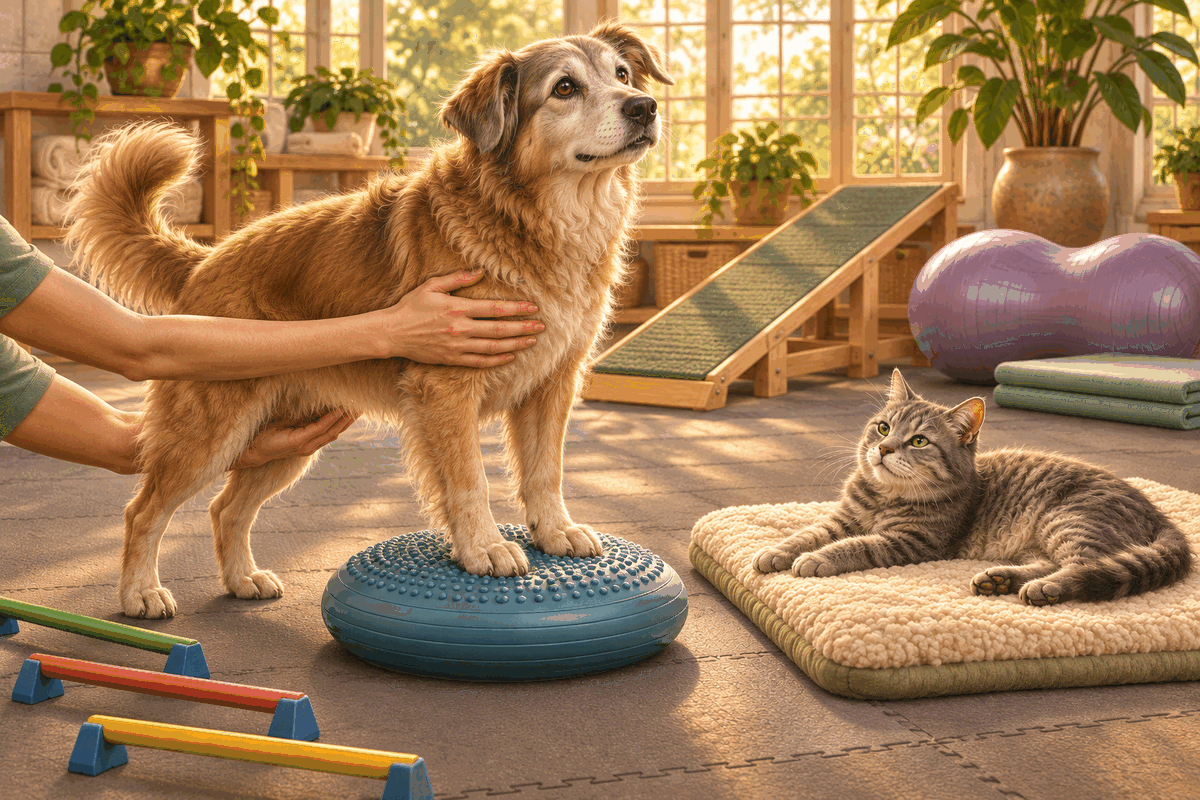
Is your cat not jumping the way they used to? Does your dog tire quickly on walks, or struggle with stairs or getting up from where they lie?
When we notice these changes, most of us say the same thing:
"They're getting old, it's normal."
But that's not always the case.
Sometimes the companions we think are simply getting older are actually having a hard time moving, feeling pain, or no longer able to do things they once did with ease.
And this isn't only about joint arthritis. Muscle weakness, hip and knee problems, spinal disc disease, and orthopedic conditions that appear genetically in some breeds can also affect mobility.
That's why physical therapy and rehabilitation for cats and dogs is an important topic, not only when a disease appears, but especially in later years, as a way to protect quality of life.
But that's not always the case.
They May Be Getting Older, But They Don't Have to Live in Pain
A dog no longer wanting long walks, getting out of bed more slowly in the morning, or being less active than before can't always be explained by age alone.
In the same way, a cat who stops jumping to high places, plays less, or spends most of the day in the same spot may not simply be showing that they are getting older.
Sometimes there is an unnoticed pain behind these changes.
Cats in particular are very good at hiding their pain. In dogs, changes such as not wanting to move, shorter walks, or avoiding stairs are easier to notice.
What matters here is to observe the things our companions used to do and can no longer do.
Because small changes in their movement can give us very important clues about their health.
Cats in particular are very good at hiding their pain.
Joint and Spine Problems Are More Common in Some Cat and Dog Breeds
Orthopedic problems can develop in any cat or dog. But because of their genetic makeup and body structure, some breeds are more often affected by certain conditions.
For example, in Scottish Fold cats, the genetic change that causes their ears to fold can also affect bone and cartilage structures. For this reason, joint pain and restricted movement can be seen even at a young age.
In Maine Coon cats, we can encounter developmental problems related to the hip joint.
The situation is similar in dogs.
In Dachshunds ("sausage dogs"), French Bulldogs, Beagles, and some other breeds in particular, there is a higher risk of disease in the discs between the vertebrae that cushion impact during movement.
When these discs shift or press on the spinal cord, they can cause pain, difficulty moving, weakness in the hind legs, and in some cases much more serious neurological problems.
In breeds such as Golden Retrievers, Labrador Retrievers, and German Shepherds, problems with the hip and elbow joints can be significant.
Of course, this doesn't mean that every animal of the breeds we listed will necessarily experience these conditions.
But knowing which health problems they are prone to helps us monitor them more attentively.
What matters is not only looking for a solution after a problem appears, but being able to notice it early.
Of course, this doesn't mean that every animal of the breeds we listed will necessarily experience these conditions.
When Your Dog Reaches Five or Six, Add Orthopedic Check-Ups to Your Agenda
We try to have our cats' and dogs' blood checked regularly, keep an eye on their heart health, and not neglect their dental care.
But how closely do we follow their joint and spine health?
Especially in dogs, from around the age of five or six, making orthopedic evaluation part of regular health check-ups is very valuable.
This age is not a medical cutoff for every dog. Large breeds may age earlier, while some small breeds can stay active until much later in life. Also, some problems, such as disc disease, can be seen in young dogs too.
That's why it's important to have a muscle, joint, spine, and gait evaluation at the intervals your veterinarian recommends, based on your dog's age, breed, weight, and health history.
We don't necessarily have to wait for a problem to appear.
How your dog walks, how comfortably they use their joints, their muscle strength, and their range of motion can be assessed during an examination. If necessary, further tests can be planned.
Just as we track blood values, tracking movement health can help us notice problems we may face in the coming years earlier.
This age is not a medical cutoff for every dog.
Physical Therapy Is Not Only Something You Do After Surgery
When we hear "physical therapy," most of us picture an animal that has had surgery or is seriously struggling to walk.
But the scope of veterinary physical therapy and rehabilitation is much broader.
In both cats and dogs, individual programs prepared after a proper evaluation may make it possible to support muscle strength, maintain mobility, help manage pain, and make daily life easier.
Of course, not every animal has the same needs.
One dog may need to strengthen their muscles, while another dog's priority may be learning to move safely again after surgery.
A cat with joint pain may need a very different, calm, stress-free rehabilitation program.
What matters here is not just applying physical therapy, but applying it to the right patient, at the right time, with the right program.
These programs should be planned with a veterinarian's evaluation and the necessary specialist support.
What matters here is not just applying physical therapy, but applying it to the right patient, at the right time, with the right program.
In Senior Dogs, Physical Therapy Can Make Life Easier for Both Them and Their Families
In my view, this is one of the topics we should especially focus on.
Families living with a senior dog know this very well.
After a while, you may start helping your dog get out of bed, supporting them on the stairs, lifting them into the car, or adjusting your walks to match their ability to move.
We do all of this with love, of course.
But over time, daily life can become a little more demanding for both our dog and for us.
This is where appropriate physical therapy and rehabilitation can offer important support.
By preserving muscle strength as much as possible, making movements more controlled, and managing pain appropriately, some dogs can carry on with their daily activities more comfortably.
This can positively affect not only our dog's quality of life, but also the daily life of the family living with them.
Because our dog being able to get up more comfortably on their own, take short walks more comfortably, or move more safely around the house means so much to all of us.
Complete recovery may not be possible in every condition. But sometimes our goal isn't to eliminate the disease entirely; it is to keep our companion's ability to move for as long as possible.
But sometimes our goal isn't to eliminate the disease entirely; it is to keep our companion's ability to move for as long as possible.
Physical Therapy and Rehabilitation Can Support Quality of Life in Cats Too
Of course, physical therapy and rehabilitation are also used in cats.
But we need to take our cats' character and behavioral needs into account.
Unlike dogs, cats can be more sensitive to procedures they find difficult or in which they don't feel safe.
That's why, in programs prepared for cats, stress management matters as much as physical needs.
Especially in cats with joint pain, reduced mobility, or who have had an orthopedic operation, appropriate rehabilitation can support day-to-day comfort.
But there's one detail we shouldn't forget here.
Our cat's ability to move comfortably isn't only about physical therapy sessions. Having a home that suits their needs is at least as important.
Because for cats, freedom of movement also means being able to control their surroundings and feel safe.
Related articleThe Biggest Hidden Dangers in Homes with CatsOur cat's ability to move comfortably isn't only about physical therapy sessions.
Small Changes You Can Make at Home: Golden Rules for Cats and Dogs
Sometimes we don't need to make big changes to make our companions' lives easier.
Even arranging their daily lives a little more carefully can bring real comfort.
1. Make slippery floors safe
Parquet and ceramic floors in particular can increase the risk of slipping in cats and dogs with joint or spine problems. Placing non-slip rugs in the areas they use most is very helpful.
2. Make it easier to reach high places
You can set up sturdy steps so your cat can reach their favorite window or sofa. For your dog, you can use a suitable ramp. This way you can reduce the need to jump from heights.
3. Choose their beds well
Especially for senior dogs, choose beds that are comfortable, supportive, easy to get in and out of, and non-slip. It's also important that beds are in easy-to-reach spots, away from drafts.
4. Make it easier to reach food, water, and the litter box
For cats, low-entry litter boxes can help cats with joint problems use their litter box more comfortably.
For dogs, arrange the position of food and water bowls taking the dog's posture and mobility into account.
5. Keep stairs and sudden movements under control
Especially in dogs with spine problems, climbing stairs, jumping from heights, and sudden turns can pose a risk. Movement restrictions should be determined by a veterinarian according to the type of condition.
6. Always keep track of their weight
Excess weight can increase the load on the joints. Maintaining an ideal weight is one of the important parts of movement health in both cats and dogs.
7. Keep them moving, but don't push them
Staying completely inactive can increase muscle loss. But the wrong exercises can also make existing conditions worse. So, especially with spine and disc diseases, always plan the exercise program with your veterinarian.
The aim of these small adjustments is very simple: to help our companions live their daily lives more safely, more comfortably, and as independently as possible.
The aim of these small adjustments is very simple: to help our companions live their daily lives more safely, more comfortably, and as independently as possible.
Don't Brush Off Changes in Their Movement as Old Age
Your cat not jumping as much as before, your dog avoiding walks, or struggling to get up from bed may be telling you something.
When you notice these changes, share them with your veterinarian.
If possible, even record short videos of their walking, stair climbing, or the movements they find difficult.
Because a behavior you observe at home doesn't always show up during an examination.
When you notice these changes, share them with your veterinarian.
In Closing…
For us, our cat jumping onto the sofa, our dog greeting us at the door, or a walk we take together may be an ordinary part of daily life.
But for them, these are the important joys of their lives.
There is a lot we can do so they don't have to give up these small joys as they age.
Regular health check-ups, problems noticed early, appropriate physical therapy and rehabilitation programs, a properly arranged living space...
They are all parts of a whole.
Because what matters is not only how many years they live, but how comfortably, happily, and contentedly they get to spend those years.
And remember, getting older is a natural part of life. But we don't have to accept pain and difficulty moving as an unavoidable result of old age.
With love,

Tülay Kayalar Durukan
Cat Behavior Consultant
Frequently Asked Questions
Is it normal for an older cat or dog to have trouble moving?
Not always. A dog not wanting long walks or getting up more slowly in the morning, or a cat that stops jumping to high places and plays less, can't always be explained by age alone; there may be an unnoticed pain behind it. It isn't only about joint arthritis either: muscle weakness, hip and knee problems, spinal disc disease, and orthopedic conditions that appear genetically in some breeds can also affect mobility. When you notice these changes, share them with your veterinarian.
Which cat and dog breeds are more prone to joint and spine problems?
Orthopedic problems can develop in any cat or dog, but some breeds are affected by certain conditions more often. In Scottish Fold cats, a genetic change affecting bone and cartilage can cause joint pain even at a young age; Maine Coon cats can have developmental hip problems. Breeds such as Dachshunds, French Bulldogs, and Beagles have a higher risk of disease in the discs between the vertebrae, while hip and elbow problems can be significant in breeds such as Golden Retrievers, Labrador Retrievers, and German Shepherds. This doesn't mean every animal of these breeds will necessarily experience these conditions.
When should orthopedic check-ups be considered for dogs?
Especially in dogs, from around the age of five or six, it is valuable to make orthopedic evaluation part of regular health check-ups. This age is not a medical cutoff for every dog: large breeds may age earlier, some small breeds stay active until much later, and some problems such as disc disease can occur in young dogs too. That's why it's important to have a muscle, joint, spine, and gait evaluation at the intervals your veterinarian recommends based on age, breed, weight, and health history. There is no need to wait for a problem to appear.
Is physical therapy only done after surgery?
No. When we hear "physical therapy," we often picture an animal that has had surgery or is seriously struggling to walk, but the scope of veterinary physical therapy and rehabilitation is broader. In both cats and dogs, individual programs prepared after a proper evaluation may make it possible to support muscle strength, maintain mobility, help manage pain, and make daily life easier. What matters is applying the program to the right patient, at the right time, in the right way; these programs should be planned with a veterinarian's evaluation and the necessary specialist support.
Are physical therapy and rehabilitation used in cats?
Yes, physical therapy and rehabilitation are also used in cats. Because cats can be more sensitive to procedures they find difficult or don't feel safe in, stress management matters as much as physical needs in programs for cats. Especially in cats with joint pain, reduced mobility, or who have had an orthopedic operation, appropriate rehabilitation can support day-to-day comfort. Having a home that suits the cat's needs is at least as important as the physical therapy sessions.
What can be done at home for cats and dogs with joint or spine problems?
Non-slip rugs can be placed in the areas they use most on slippery floors. Sturdy steps for cats and a suitable ramp for dogs reduce the need to jump from heights. Especially for senior dogs, choose beds that are comfortable, supportive, easy to get in and out of, and non-slip; low-entry litter boxes can help cats with joint problems. The position of food and water bowls should suit the animal's posture and mobility, and an ideal weight should be maintained. Staying completely inactive can increase muscle loss, while wrong exercises can worsen existing conditions; especially with spine and disc diseases, movement restrictions and the exercise program should be determined by a veterinarian.
Which signs mean you should see a veterinarian urgently instead of waiting for a routine check-up?
In case of signs such as sudden-onset hind-leg weakness, inability to walk, severe pain, or a sudden loss of urinary control, do not wait for a routine check-up; see a veterinarian urgently.
Support at home for your senior or special-needs companion
In GM Pet Sitter's Health & Clinical Support service, your companion's health process is followed at home according to your veterinarian's treatment plan and with veterinary technician support. Custom daily care plans are created for senior companions, those with limited mobility, or those with special care needs. Diagnosis and treatment planning always remain with your veterinarian.